


Subhashini Natarajan
Director - Automation and AI COE
5 min read
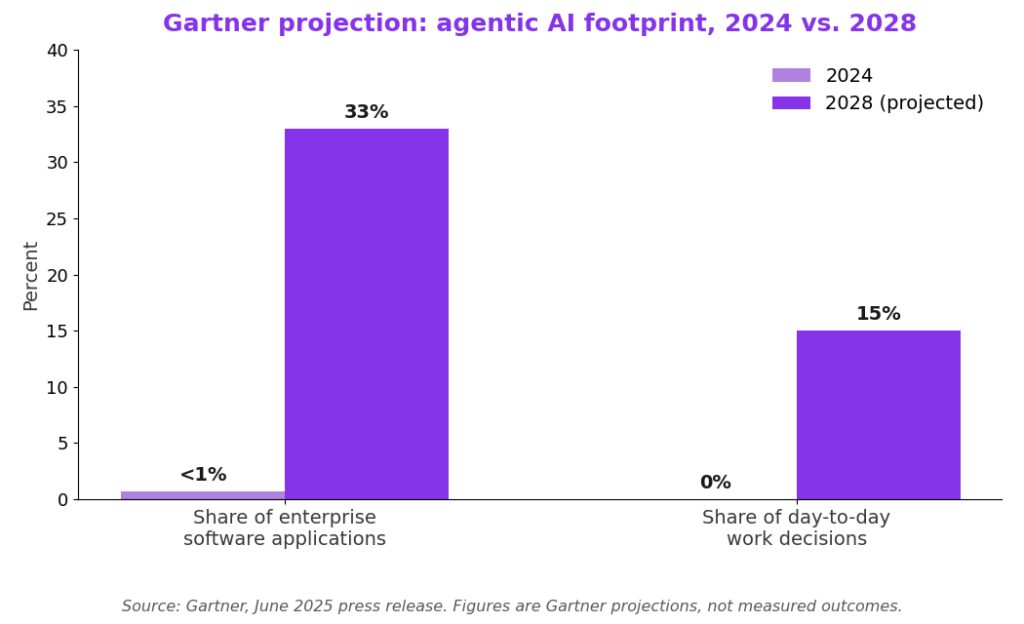
Agentic AI is projected to run inside a third of enterprise software by 2028. That is up from under 1 percent in 2024, according to Gartner. That curve is already reshaping your budget cycle for next year, whether or not you have a single deployment live. CTOs and CIOs are the ones asked to close that widening gap. Wait too long and a competitor sets the governance standard for your industry instead of you. Most vendors slap the label on everything they sell.
Most analysts define it differently too. Your board wants a straight answer on what is agentic AI, not another slide of buzzwords. Generative AI reacts to prompts, but agentic AI plans, decides, and acts across multiple steps with limited human oversight. That distinction changes how you budget, govern, and staff for what comes next. Get it wrong and you fund the wrong pilot, or worse, the wrong governance model. This guide skips the hype. You get a clear definition, real adoption numbers, and a deployment framework built for enterprise governance, not another vendor pitch.
The Gap Between Agentic AI Investment and Results
Agentic AI is a system built on generative AI models that plans, decides, and takes multi step action toward a goal with limited human oversight. Unlike a chatbot that answers one prompt at a time, an agentic system chains reasoning, tool use, and decisions together to complete a task from start to finish.
Enterprise appetite for agentic AI is not in question. PwC’s 2025 AI agent survey found that 88 percent of senior executives plan to increase AI related budgets specifically because of agentic AI capabilities.
Production reality tells a different story. Deloitte’s 2026 research on enterprise agentic AI strategy found that only 11 percent of organizations are actively using agentic solutions in production today, even as most expect to expand agent use within two years. Gartner’s 2025 analysis of agentic AI project failures goes further, predicting that enterprises will cancel more than 40 percent of these projects by the end of 2027, citing escalating costs, unclear business value, and inadequate risk controls.
Enterprises will cancel more than 40% of agentic AI projects by the end of 2027
Gartner, June 2025
That gap between intention and delivery is not a reason to wait. It is a signal that most failures trace back to data readiness and workflow design, not the underlying models. Enterprise teams that treat agentic AI like a bigger chatbot rollout tend to land inside Gartner’s cancellation numbers. Teams that treat it like a new operating model tend to land outside them. That gap matters most for the operations, data, and platform teams who must make the numbers real.
Generative AI, AI agents, and Agentic AI are Not The Same Thing
These three terms get used interchangeably in vendor decks, and that habit costs enterprise teams real money when they scope the wrong project.
Generative AI creates content in response to a prompt. It writes a paragraph, drafts code, or renders an image, then waits for the next instruction. A person stays in the loop for every step.
An AI agent is a single software entity that pursues a defined goal with less supervision. It uses tools, holds memory, and completes multi step tasks, using a generative model as one internal component. It solves one narrow problem well.
Agentic AI is the broader architecture. McKinsey’s analysis of agentic AI in the enterprise defines it as a system, built on generative AI foundation models, that can act in the real world and execute multistep processes. One or more agents plan, coordinate, and act toward a higher level goal with minimal human oversight. That is the point where AI stops assisting a task and starts driving a process, and it is why governance questions that generative AI never raised suddenly matter.
MIT Sloan’s explainer on agentic AI frames the distinction the same way, describing agentic systems as autonomous software that perceives, reasons, and acts on behalf of a human principal, not simply a more capable chatbot.
Consider a claims processing workflow. A generative AI tool can draft a summary of an incoming claim when an adjuster asks for one. An AI agent can pull the claim file, check it against policy rules, and flag exceptions on its own. An agentic system can do all of that and then route the claim, request missing documents, and escalate disputed cases, coordinating several specialized agents without a person triggering each step.
That layered example is why vendors blur the lines. Marketing language rewards the biggest claim, and agentic AI sounds more impressive than AI agent, which sounds more impressive than generative AI. Enterprise buyers who understand the real distinction, rather than the marketing distinction, negotiate better contracts and set realistic pilot scope from day one.
This distinction also changes what you should ask a vendor before you sign anything. A team that answers agentic AI when you ask what their product actually does needs a follow up question. Are they describing a single agent handling one task, or a coordinated system making decisions across an entire process. The vaguer the answer, the more diligence your procurement and security teams should plan for before pilot access, let alone production access.
What Agentic AI Changes for Your Operating Model
How agentic AI actually works
Most agentic systems follow a similar loop. The system perceives its environment through data feeds, documents, or application interfaces. It reasons about what action would move it toward its goal, drawing on a generative model for that reasoning. It acts by calling a tool, updating a record, or triggering the next step in a workflow. It then evaluates the result and either continues, escalates to a person, or stops. IBM’s technical breakdown of how agentic AI systems operate is a useful reference for architecture teams scoping their first deployment.
Decision rights and human oversight
The hardest design question is not technical. It is deciding which decisions an agent can make alone and which require a person to approve first. Teams that skip this step tend to either over restrict the system, which erases the efficiency gain, or under restrict it, which creates compliance exposure the first time an agent acts on bad data.
Budget for the coordination layer, not just the model
Multi agent systems add orchestration cost that a single chatbot never had. You need logging for every agent decision, a way to trace which agent took which action, and a budget line for the compute agents consume when they retry a failed step. Finance teams that model these systems like a software license miss most of the real cost. That coordination layer also needs monitoring dashboards that show which agent handled which decision, which is where a mature business intelligence practice pays off quickly.
Enterprise teams that move from pilot to production tend to follow a similar sequence.
- Pilot a single, well bounded workflow. Choose a process with clear rules and low regulatory risk, and measure the baseline before the agent touches it.
- Integrate the agent with your existing systems of record. An agent that cannot read or write to your core platforms will never leave the sandbox.
- Build the governance layer before you scale. Define decision rights, escalation paths, and audit logging while the deployment is still small enough to fix mistakes cheaply.
- Scale to adjacent workflows only after the first one holds. Teams that scale several workflows at once before proving the model tend to be the projects Gartner counts among the 40 percent that get canceled.
Why your data layer decides whether agentic AI works
Agentic systems are only as good as the data and interfaces they can reach. An agent connected to clean, well modeled data and a modern integration layer can act with confidence across systems. An agent connected to spreadsheets, siloed databases, and undocumented APIs spends most of its effort guessing instead of acting. Enterprise teams that have already invested in data modernization and integration work move through the four stage path above faster, because the hardest part of deployment is rarely the agent itself. It is everything underneath it.
What Enterprise Teams Get Wrong About Agentic AI
The first misconception is treating agentic AI as a faster version of the chatbot your teams already use. A chatbot answers when asked. An agentic system initiates action on its own, which means the failure modes are different too. A wrong chatbot answer wastes a few minutes. A wrong agent action can touch a customer record, a payment, or a compliance filing before anyone notices.
The second misconception is treating full autonomy as the goal. The organizations scaling this technology successfully keep a person in the loop for high stakes decisions rather than removing people entirely. Autonomy is a dial, not a switch, and the teams that get the most value tune it deliberately for each workflow.
The third misconception is blaming the model when a pilot stalls. In most stalled deployments, the underlying model works fine. The problem is data that lives in five disconnected systems, a workflow that was never mapped clearly enough for an agent to follow, or an approval process nobody automated. Fixing the model does not fix any of that.
Teams that name these three misconceptions early spend less time firefighting later. They also set expectations with their board that match what the technology can actually deliver this year, rather than what a vendor demo suggested it could deliver.
What to Monitor Before You Scale Agentic AI
Three signals tell you whether your organization is ready to expand agentic AI beyond a pilot.
Governance maturity is the first signal. The production numbers cited earlier already point to where most organizations stand today. If your organization does not have documented decision rights and escalation paths yet, scaling before you build them multiplies the risk instead of the value.
Data readiness is the second signal. Agents make decisions from whatever data they can reach. Fragmented, stale, or poorly governed data produces confident, wrong decisions faster than any person ever could, and an agent will not flag its own uncertainty the way a cautious employee might.
Workforce trust is the third signal. Employees who do not trust an agent’s output route around it quietly, and the pilot dies without anyone officially canceling it. Ask the people who work with the system daily whether they trust it before you ask whether it technically works.
None of these signals require expensive tooling to check. A short internal audit of your top three candidate workflows, covering data quality, decision ownership, and current trust levels, tells you more about scaling readiness than another vendor demonstration will. Enterprise teams that treat these three signals as a gate before scaling, rather than a checklist to complete afterward, are the ones more likely to land on the right side of the industry’s adoption numbers instead of inside them.
-
What is agentic AI?
Agentic AI is a system built on generative AI models that plans, decides, and acts across multiple steps to reach a goal, with limited human oversight. It differs from a standard AI tool because it initiates action rather than waiting for a prompt at every step, coordinating tasks such as data lookups, approvals, and system updates on its own.
-
What is the difference between agentic AI and generative AI?
Generative AI creates content, such as text, code, or images, in response to a single prompt, then waits for further instruction. Agentic AI goes further. It uses generative models as one component inside a system that plans multiple steps, makes decisions, and takes action toward a goal without a person triggering each individual step.
-
What is the difference between agentic AI and an AI agent?
An AI agent is a single software entity that pursues one defined goal with limited supervision. Agentic AI is the broader architecture, coordinating several specialized agents that plan, communicate, and act together toward a larger business outcome, rather than one agent handling one narrow task in isolation.
-
What are the biggest risks of adopting agentic AI?
The leading risks are weak governance, poor data quality, and unclear decision rights, not the underlying model. Analysts predict enterprises will cancel more than 40 percent of agentic AI projects by 2027 due to escalating costs, unclear business value, or inadequate risk controls, and most of those failures trace back to planning gaps rather than technology limits.
The agentic AI question in front of your organization was never really about the technology. The models work well enough today to support real deployments. What separates the enterprises whose production numbers hold up from the ones expected to cancel their projects by 2027 is whether governance, data readiness, and decision rights got built before the agent went live, not after.
Your next planning cycle is the right moment to run that readiness check, before you commit budget to a wider rollout. Start with one workflow, name who owns which decision, and measure what changes once an agent is inside the process.
-
How does agentic AI work?
Most agentic systems follow a loop. The system perceives data from documents, feeds, or applications, reasons about the best next action using a generative model, acts by calling a tool or updating a record, then evaluates the result and decides whether to continue, escalate to a person, or stop.
Explore BayOne’s AI services
https://bayone.com/artificial-intelligence-services/
See how enterprise teams build the data and governance foundation agentic AI deployments need to succeed.