


Sanjay Kalra
Vice President, Client Solutions & Strategy
8 min read
Every AI development company on your shortlist rents the same gym. Same foundation models. Same GPUs, from the same three clouds. Same open-source frameworks, pulled from the same repositories on the same release cadence. The equipment stopped being a differentiator two years ago.
What does not commoditize is your playbook. The pricing exceptions your team learned the hard way. The claims that always get kicked back and why. Twenty years of decisions nobody wrote down.
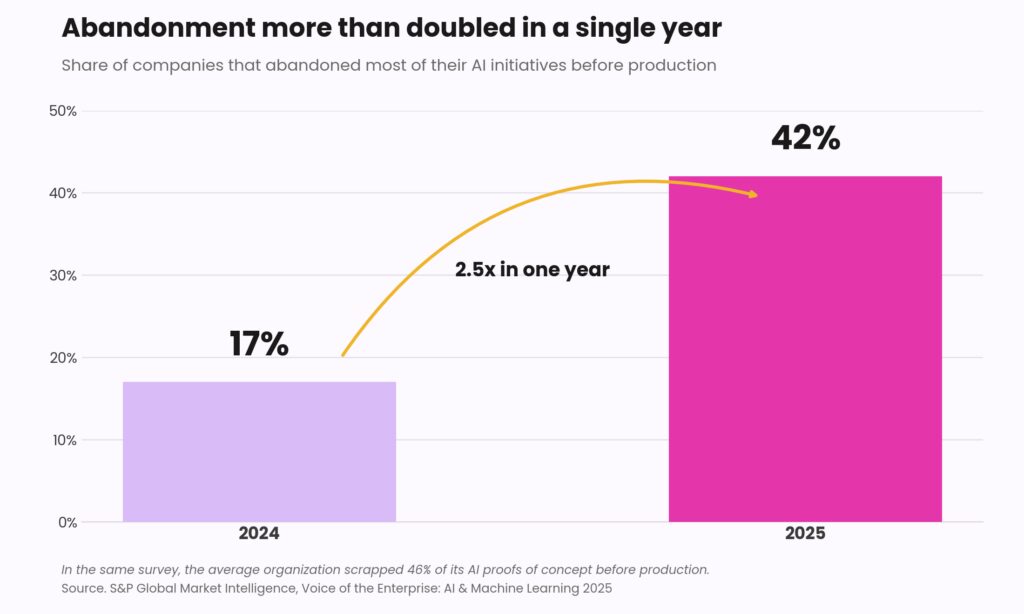
S&P Global’s 2025 survey found 42% of companies abandoned most of their AI initiatives before production. A year earlier that number was 17%. Those programs did not die on model quality. They died because nobody captured the playbook.
So the vetting question changes. Every firm on your list can build the system. Far fewer will leave your organization holding the playbook when the engagement ends.
What follows is a four-part diagnostic for CTOs, VPs of Engineering and heads of technology choosing an AI development partner. It covers what to ask, what the answers mean, and which failures wait until month seven.
The gym is rented. The playbook is not.
Evaluating an AI development company means testing playbook retention, not technical capability. Models, compute and frameworks are rentable by anyone with a credit card. The durable asset is your institutional context encoded into working systems. Firms that transfer that context deliver production value. Firms that keep it deliver demos.
Marc Benioff put the commoditization argument plainly in January 2026. “Over time, LLMs will become more of a commodity layer, chosen less for uniqueness and more for performance, efficiency, and availability,” he wrote. “What we build on top of the LLM, the trusted data and workflows that connect AI to the way we work and live, matters most.”
That is the whole selection problem. The layer every vendor competes on in a capabilities deck is the layer that costs the least to acquire. The layer that decides whether your program survives sits in your own operating history. Most firms never ask for it.
I have watched this play out on both sides of the table. A firm arrives with a strong reference architecture and a demo built on public data. Six weeks in, someone finally asks how the client handles partial shipments. The answer takes three days to assemble, because the four people who know it sit in different functions. That conversation is the engagement. Everything before it is setup.
Where AI development ROI actually goes
McKinsey’s State of AI 2026 shows the shape of the problem. Nearly nine in ten organizations regularly use AI in at least one business function. 44% report AI scaling across the enterprise, up from 38% a year earlier. Only 37% attribute any EBIT impact to it. The share reporting 5% or more EBIT impact has stayed flat near 6% for two years.
Nine in ten enterprises are using AI somewhere. Six in a hundred can point at real money. A gap that stable across two survey cycles is structural, and it lives in how programs get scoped and staffed.
What the market looks like in 2026
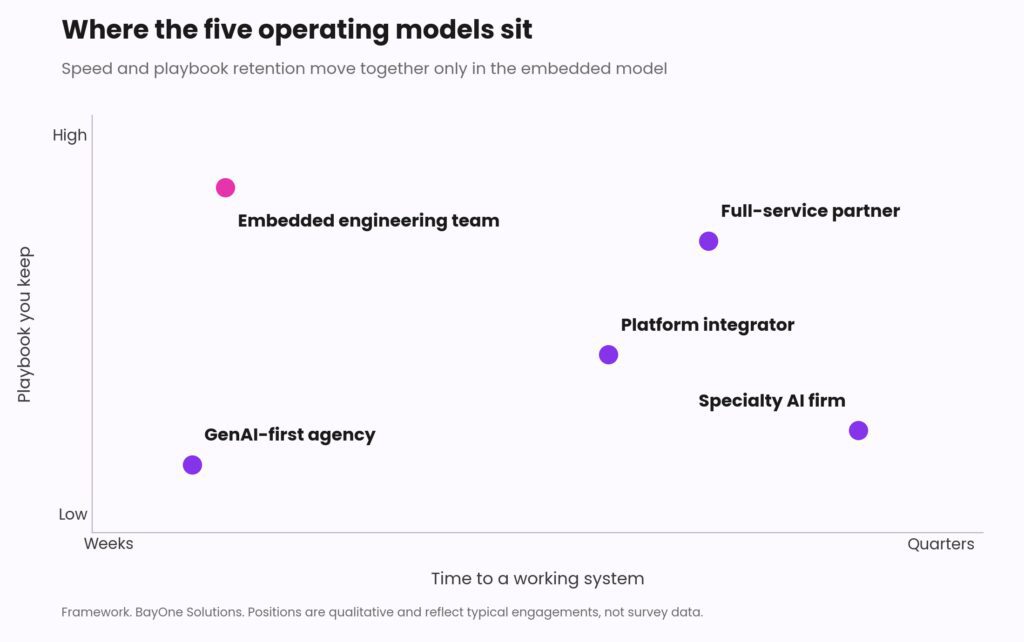
Enterprise AI development partners cluster into five operating models. Each one holds your playbook differently. Time to value, cost and ownership burden all follow from that difference. Matching the model to your internal maturity matters more than comparing credentials inside a single category.
Specialty AI firms
Deepest technical capability in the market. They handle custom model work, fine-tuning and machine learning development that off-the-shelf platforms cannot replicate. Their weakness sits on the organizational side. A custom AI development company built around research engineers produces excellent model work and struggles with the change management that decides whether anyone uses it.
Full-service technology partners
The strongest profile for most enterprise AI development programs. This kind of enterprise technology partner covers data engineering, model development, AI model deployment and post-launch optimization inside one engagement structure. Commercial terms need more scrutiny and coordination overhead runs higher. For a multi-year roadmap, single-throat accountability across AI integration usually pays for itself.
GenAI-first agencies
Real speed to demo, and the right call for validating a use case in weeks. The problem is what happens next. A generative AI development company selling generative AI development services is typically configured for short modular engagements. The systems they ship are rarely architected for enterprise scale, compliance or AI governance. Many teams have commissioned a working demo and inherited a prototype no production group will adopt.
Platform integrators
These firms deliver AI implementation on Azure, AWS or Google Cloud native services. Fast, predictable and well documented, with strong reference patterns and certified engineers. The tradeoff is platform dependency. Your playbook ends up encoded in one vendor’s managed services, and custom work outside that boundary tends to be thin.
Embedded engineering teams
An AI software development company operating on the embedded model places engineers inside your teams under your technical direction. Knowledge accumulates in people who stay. The model transfers playbook by construction rather than by documentation milestone. It also demands real internal engineering leadership, because you supply the architecture and the priorities.
| Model | What they build | Time to value | Playbook retention | Where they underperform |
|---|---|---|---|---|
| Specialty AI firm | Custom models, fine-tuning, production ML pipelines | 6 to 18 months | Low to moderate | Change management and production ops handover |
| Full-service partner | End-to-end AI development services across data, model and deployment | 4 to 12 months | Moderate to high | Cost and scope complexity, needs strong internal program management |
| GenAI-first agency | Rapid prototypes, LLM integrations, agentic AI development | 4 to 8 weeks for a POC | Low | Proof of concept to production gap, thin on enterprise data architecture |
| Platform integrator | Implementations on Azure, AWS or Google Cloud AI services | 6 to 12 months | Moderate, locked to one platform | Platform dependency, limited custom model capability |
| Embedded engineering team | Engineers inside your teams under your technical direction | 2 to 6 weeks to a working pod | High | Requires internal architecture ownership and technical leadership |
The four-part diagnostic
These firms deliver AI implementation on Azure, AWS or Google Cloud native services. Fast, predictable and well documented, with strong reference patterns and certified engineers. The tradeoff is platform dependency. Your playbook ends up encoded in one vendor’s managed services, and custom work outside that boundary tends to be thin.
Dimension one. Is your data treated as the playbook
Ask the firm to describe the last engagement where data quality stopped their progress. Anyone who has run enterprise AI deployment at scale has a specific and slightly painful answer. A generalized response about best practices tells you they have not been there.
Then ask what share of their AI readiness assessment goes to data versus solution scoping. Gartner predicted in February 2025 that organizations would abandon 60% of AI projects unsupported by AI-ready data through 2026. Firms with production experience front-load that work, because they have already paid for skipping it.
Dimension two. Who holds the playbook at each phase
Ask how the team structure changes between proof of concept and production. If the answer describes one team across both phases, ask for a case study at your scale. If it describes a transition, ask what gets handed over and what usually breaks in the transfer.
The useful follow-up is who writes the evaluation set. Eval design forces someone to articulate what correct output looks like in your business. A firm that writes your evals without you has quietly taken custody of your domain logic.
Dimension three. What is still running in month twelve
One question cuts through portfolio presentations faster than any other. Of the AI systems you delivered in the last two years, what share run in production today? A credible firm gives you a number. A less credible one explains why the number is hard to quantify.
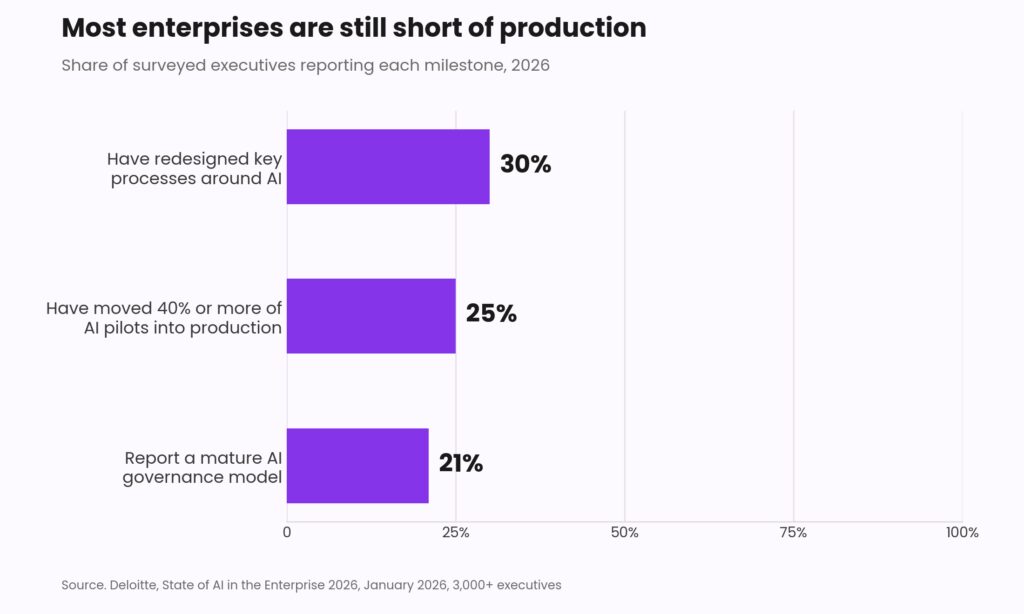
Deloitte’s 2026 enterprise survey found only 25% of organizations have moved 40% or more of their AI pilots into production. Just 30% have redesigned key processes around AI, and 21% report mature AI governance. Reference calls should target the period six months after go-live, where demo quality and a durable production AI system separate.
Dimension four. Who owns the playbook after drift
Ask what happens when model performance degrades three months post-launch. Strong AI development partners build model monitoring and retraining into the delivery model. They will describe how it is staffed and what the escalation path looks like. Weak ones defer it to a future statement of work.
Pete Johnson, Field CTO for AI at MongoDB, framed the ownership question directly in April 2026. “Who owns AI in the enterprise? Is it centralized in IT? Federated across business units? CIOs who don’t make a deliberate choice end up with chaos by default.” The same applies to the boundary between your team and your partner. Undefined ownership defaults to nobody.
The risks that surface in month seven
Every evaluation catches the obvious risks. These four arrive after signature, and each one destroys playbook retention specifically.
Scope compression eats the playbook first
When timelines slip, the deferred items are data architecture work, evaluation design and production hardening. Those are the playbook components. A firm’s willingness to hold that line under schedule pressure tells you more than any technical credential. Ask what they cut on their last delayed program and what they refused to cut.
The demo-first pattern
Some AI development companies are optimized for winning work rather than delivering it. Impressive early demonstrations build executive sponsorship, then architectural problems surface once production build starts. The diagnostic is simple. Ask them to walk you through their architecture review process before any code gets written. Firms with production discipline have one and can describe it in detail.
Knowledge transfer treated as documentation
AI systems your team cannot maintain are liabilities. Models drift, retraining becomes routine, and a handover document written in the final sprint will not carry it. The strongest firms build capability transfer into delivery milestones from week one. Ask how they have measured transfer success before. A vague answer is itself the answer.
The reverse information paradox
This one gets discussed least and costs most. Over a long engagement your partner accumulates a working model of how your business operates, encoded in prompts, evaluation sets and exception handling logic. That knowledge is portable. Some of it will surface in the accelerator they pitch to your competitor next quarter. Ask who owns the evaluation data, the prompt libraries and the fine-tuned weights. Get it into the contract rather than the kickoff deck.
Making the call
AI partner selection comes down to matching an AI operating model to your internal capability and the stage your program is at.
Thin data foundation and a small internal AI team means you need real data engineering depth from a partner who treats readiness as a precondition. A GenAI-first agency or an AI agent development company will outrun your foundation and hand you demos that never ship.
Solid data foundation and an engineering team that can own production afterward means a specialty firm may give you more depth per dollar. Confirm their transition includes a real handover period with your people rather than a document.
A multi-year program across several business functions points to the full-service model almost every time. The alternative of managing five specialists with nobody accountable for the integration layer produces the failures that fill every AI project failure post-mortem.
Strong internal architecture leadership and a hiring constraint rather than a capability gap points to the embedded model. You keep the playbook by construction, and you carry the cost of directing the work.
The MIT NANDA team studying failed generative AI pilots found the successful minority shared a pattern. As lead author Aditya Challapally put it, “they pick one pain point, execute well, and partner smartly with companies who use their tools.”
Frequently asked questions
What is the most important thing to evaluate in an AI development company?
Production track record. Ask what share of a firm’s delivered AI systems are in active production use today. Portfolio depth and technical credentials matter less than evidence a firm closes the proof of concept to production gap. That discipline is what most enterprise AI programs lack.
What is the difference between a specialty AI firm and a full-service AI development partner?
A specialty AI firm focuses on model development, fine-tuning and ML pipeline construction, offering deep capability with limited change management support. A full-service AI consulting firm covers the end-to-end stack from data engineering through deployment. It costs more and carries accountability for the integration layer specialists leave uncovered.
How do I know if an AI development company can handle my data architecture?
Ask the firm to describe the last engagement where data quality blocked their timeline. Genuine enterprise experience produces a specific answer about what broke and how they fixed it. Also ask what share of pre-engagement assessment time goes to data readiness, since production-experienced firms front-load that work.
Why do so many enterprise AI projects fail even with an experienced partner?
Most failures are organizational rather than technical. S&P Global’s 2025 research found the average organization scrapped 46% of its AI proofs of concept before production. Common causes include misaligned operating models, weak data readiness and engagements structured to deliver a demo. Internal governance quality determines whether any partner succeeds.
What should I ask AI development company references?
Ask about the period six months after go-live. Whether the system is still actively used, who owns maintenance and retraining, and what scope got deferred during delivery. References describing smooth demos and difficult post-launch periods are telling you the firm optimizes for delivery over durability.
How long does it take to move from AI proof of concept to production?
Gartner research put the average at eight months from prototype to production, based on data collected in late 2023. That assumes AI-ready data already exists. Engagements requiring data architecture work upstream of model development add three to six months depending on environment complexity and governance requirements.
The question your evaluation should answer
Choosing an AI development company is not a procurement exercise. It is a decision about which firm takes your organization from a working proof of concept to a system your team owns, maintains and extends.
The 42% abandonment rate is not a verdict on AI technology. It is a verdict on fit between what a firm is built to deliver and what an enterprise needs to scale. Every one of those programs had access to the same models as the programs that worked.
Run the four-part diagnostic before the contract, while the answers still change the decision. After the demo has built internal momentum, the evaluation stops being an evaluation.
Discover how BayOne’s AI and GenAI engineering services help enterprise teams move from proof of concept to production-grade AI. https://bayone.com/artificial-intelligence-services/