

A black and white photo of the city skyline.

The Real AI Hiring Crisis Isn’t the Talent Shortage. It’s the Noise.

The Real AI Hiring Crisis Isn’t the Talent Shortage. It’s the Noise.

Sanjay Kalra

AI Transformation Sherpa™ | VP, Client Solutions and Strategy

Suva Sharma

VP, Digital Transformation Services, Product Leader

6 min read

Every recruiter I talk to right now is describing the same problem, just with different numbers attached to it.

Their inboxes are full of resumes that all read like the same job description, because in a lot of cases, they were written by the same tool. AI-generated resumes have gone from novelty to default. Fraudulent and AI-assisted candidates are now the top hiring concern for 2026, ahead of the old standby, “not enough qualified people.” Some of them are getting all the way to the interview using AI-generated answers, cloned voices, even live deepfake video. Gartner expects one in four candidate profiles worldwide to be fake by 2028. That is not a talent shortage. That is a trust problem wearing a talent shortage’s clothes.

Underneath that noise, the real shortage is there too, and it’s worst in exactly the places enterprises need it least. There are roughly 1.6 million open AI roles globally against about 518,000 qualified candidates. For agentic AI specialists specifically, it’s closer to six to eight open roles for every qualified engineer. AIOps and SRE talent commands premiums for the same reason: everyone needs it, almost nobody has it, and the people who do have it aren’t applying to job postings, they’re getting recruited away from each other.

 Here’s what should get every HR and Talent Acquisition leader’s attention: this isn’t a problem unique to companies without a strong employer brand. OpenAI is racing to nearly double headcount this year and still can’t fill roles fast enough. Anthropic is in the middle of hypergrowth with hundreds of open positions. The Big Four are all building out AI and agentic practices and competing for the same small pool of people who can actually ship reliable agents, not just talk about them. If the companies building the frontier models are struggling to hire for AI roles, “post it on LinkedIn and wait” was never going to be an enterprise’s answer either.

This is also where I think the broader AI conversation has been slightly off for the last two years. We spent that time debating which model is smartest. The market has moved on. The constraint on AI value today isn’t model capability, it’s services and human expertise: the unglamorous work of governance, workflow integration, change management, and domain-specific judgment that turns a pilot into something that survives contact with a real business process. Multiple analyses now put roughly 80% of the work required to move AI from pilot to production in exactly that category, not in model selection. That’s why the winners in this next phase of enterprise AI won’t be the companies with the best model access. Everyone has that now. It will be the companies that pair AI with deep domain expertise and disciplined delivery.

That belief is exactly why we built BayOne Talent AI™ the way we did.
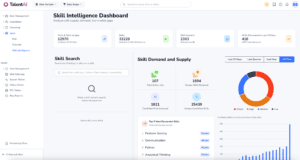
Talent AI Dashboard
Talent AI Dashboard

We didn’t start with a model and go looking for a use case. We started with fourteen years of running talent acquisition as a technology services business, watching where recruiters actually lose time, where good candidates get missed, and where “AI-powered” hiring tools were quietly making the fake resume problem worse instead of better. Then we built an agentic system around that domain knowledge: language models and vision models for parsing and understanding, embeddings for search that catches candidates keyword matching misses, and an agentic workflow engine that automates the repeatable parts of the job while keeping a human in the loop for every decision that actually affects someone’s career.

60–80%

Reduction in false positives

<2 Min

Resume analysis time, down from up to 1 hour

75–90%

Search precision, up from 30–40%

30–50%

Of candidates return for the next opportunity after receiving feedback and being matched to relevant roles

The authenticity piece matters most given everything above. BayOne Talent AI™ validates candidates by checking whether their experience, skills, and work history actually connect the way a real career does, which is exactly the pattern that AI-generated and keyword-stuffed resumes fail. In production, that’s meant a 60 to 80% reduction in false positives, resume analysis dropping from as much as an hour to under two minutes, and search precision moving from the 30 to 40% range up to 75 to 90%. It’s also meant something I care about just as much: candidates who don’t get the role still get real feedback and get routed to roles that fit, instead of disappearing into a black box. Somewhere between 30 and 50% of them come back for the next opportunity.

None of that is a bet on AI replacing recruiters. It’s the opposite. It’s what happens when you give experienced talent acquisition professionals an agent that handles the volume and the noise, so they can spend their time on the judgment calls that were always the actual job, especially for the hardest roles to fill: AI Engineering, Agentic AI, AIOps, SRE, the exact skill sets everyone from OpenAI to the Big Four to your own company is fighting over right now.

The AI talent war won’t be won by whoever adopts the flashiest model. It will be won by whoever combines real domain expertise with disciplined engineering fastest. That’s the bet we made with BayOne Talent AI™, and it’s the bet I’d encourage every HR and TA leader reading this to make in your own function, before the noise gets any louder.

Finding authentic talent shouldn't be this hard.

AI is changing recruiting quickly, and every organization is navigating it differently. If you’d like to see how BayOne Talent AI™ helps teams identify authentic candidates faster and hire with greater confidence, fill out the form below. We’d be happy to connect.